You Think What You Consume. You Make What You Think.
"Every reference leaves something behind."
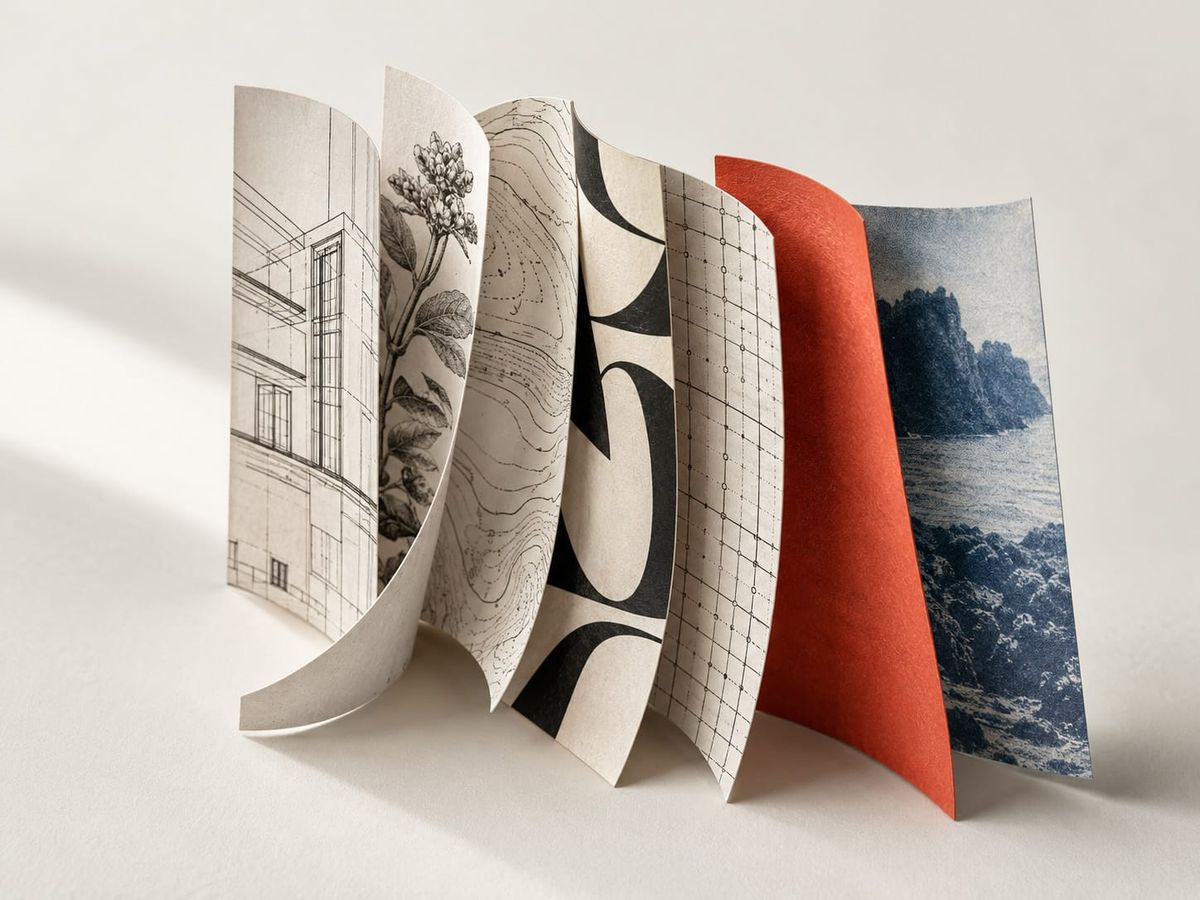
Look at the work you admire.
Now look at the work you produce.
The two are closer than you realise.
Every day you absorb ideas about type, colour and composition.
Some come from research and the references you save.
Others arrive through a feed, a book, a conversation or something you pass on the way to work.
You do not need to save an image for it to shape your next decision.
What you see repeatedly becomes familiar.
Familiar choices feel right, so you make them again.
Exposure Comes Before Taste
Picture a designer who scrolls Instagram for forty minutes before she opens a file.
Her feed repeats the same few accounts in three or four styles.
Forty minutes every working day adds up to roughly 160 hours a year.
Four working weeks spent looking at the same narrow selection of work.
Over time, her idea of a good book cover begins to resemble what she sees most often.
The algorithm selects what appears.
Her scrolling reinforces the selection.
The result shows in her first sketches.
A heavy grotesque, tight tracking, and a gradient behind the title.
Three concepts for one brief look like one concept in three weights.
The reference set was identical before the work began.
When three concepts look interchangeable, price becomes the easiest way to separate them.
You do not pick your influences.
You pick your habits, and the habits pick the influences.
Thinking follows the same route.
A brief arrives, and you reach for the solutions you saw most recently, because recent solutions arrive fast.
Fast feels like skill.
It is memory.
Distance Produces Difference
Take a second designer.
Her reading covers railway timetables, hospital signage, post-war paperbacks and Polish film posters.
Her references come from outside the field, so her starting points do too.
A jacket borrows its grid from a timetable.
A poster borrows its hierarchy from a ward sign.
A map ranks place names at several sizes on one sheet.
The same ranking fits a festival poster.
Familiar sources encourage familiar solutions.
Distant sources offer starting points you might otherwise overlook.
Unusual references guarantee nothing.
Copy the surface of a Polish film poster and you have made another imitation.
Study how its designer handles tension, scale and hierarchy, and you have learned something to apply to an entirely different problem.
Distance has a cost.
Unfamiliar sources take longer to read, and the first weeks of the habit feel slow.
The slowness is part of the learning.
You are building references you did not own before.
Business thinking follows the same pattern.
Read only complaints about late payment, scope creep and difficult clients, and you begin expecting problems before the next client has given you a reason.
The client never gave you those expectations.
Your reading did.
Changing the Intake
You do not need to delete your feeds.
You need to know what they teach you.
Spend time with material outside contemporary graphic design.
Architecture, literature, photography, historical print, scientific illustration or industrial design.
Read a chapter or study one printed page before you open a feed.
Twenty minutes, five days a week, adds up to over eighty hours across a year.
A saved folder of two thousand images stores style and teaches little about structure.
Ten minutes with one poster shows you how grid, scale and margin work together. Two hundred posts at one second each show you the surface.
Ask why a typeface works.
Why the designer chose this scale, why the margins feel balanced, why the hierarchy directs your eye.
Look back at your last five projects.
Notice the typefaces, colours and compositions you return to.
Which decisions came directly from the brief?
Which came from habit?
Think about what you've been reading, watching and studying.
Look for connections between those influences and the work you've produced.
I have made over a thousand typographic posters since 2017.
Repetition builds skill, and it builds defaults.
A typeface, a layout, a particular way of arranging letters.
Something works once, and reaching for it again becomes easier.
Your finished work becomes input for the next job.
Familiarity decides before you notice.
Every designer works from what they have seen.
The question is whether you chose it.
Closing Thought
Every reference leaves something behind.
It shows in your work whether you recognise it or not.
🪶 Want more creative insights each Sunday?
Read more on the blog → / Join on Instagram →

Another Newsletter
A fortnightly essay on creative practice and freelance life.
New posters appear between editions.